By: Kevin Frank, Michigan State University Department of Plant, Soil and Microbial Sciences -
Spring has arrived and although the weekly roller coaster ride of temperatures continues, many people are venturing outside to work in their lawns. When is the best time to apply preemergence herbicides is a common question as spring arrives and lawns start growing again. There are several different methods used for determining the optimum application timing from tracking growing degree days (GDD) to looking for forsythia bush flower bloom. One system used by both professional turfgrass managers and do-it-yourselfers to determine application timing is to track GDDs using the website GDDTracker.
GDDTracker starts counting GDDs on Feb. 15. The crabgrass preemergence model uses GDD (base 32 degrees Fahrenheit) to indirectly measure soil temperatures in a turf situation (enter your zip code under the map and then click on “Crabgrass PRE”). The GDD model attempts to predict the optimum application timing for when the 0-2 inch depth soil temperatures consistently reach 50-55 F. Applications made at this time provide adequate time for the preemergence herbicide to be applied and watered in before crabgrass germination occurs.
Summer annual grasses such as crabgrass require proper soil temperature and moisture to germinate and establish. Eighty percent of germination will occur when soil temperatures at the 0-2 inch depth are consistently between 60 and 70 F. For preemergence herbicides to be effective, they need to be applied before the soils reach this optimum temperature range. At the Hancock Turfgrass Research Center on Michigan State University’s campus, soil temperature at a 2-inch depth is still just above freezing so it will still be some time before there will be any crabgrass germinating.
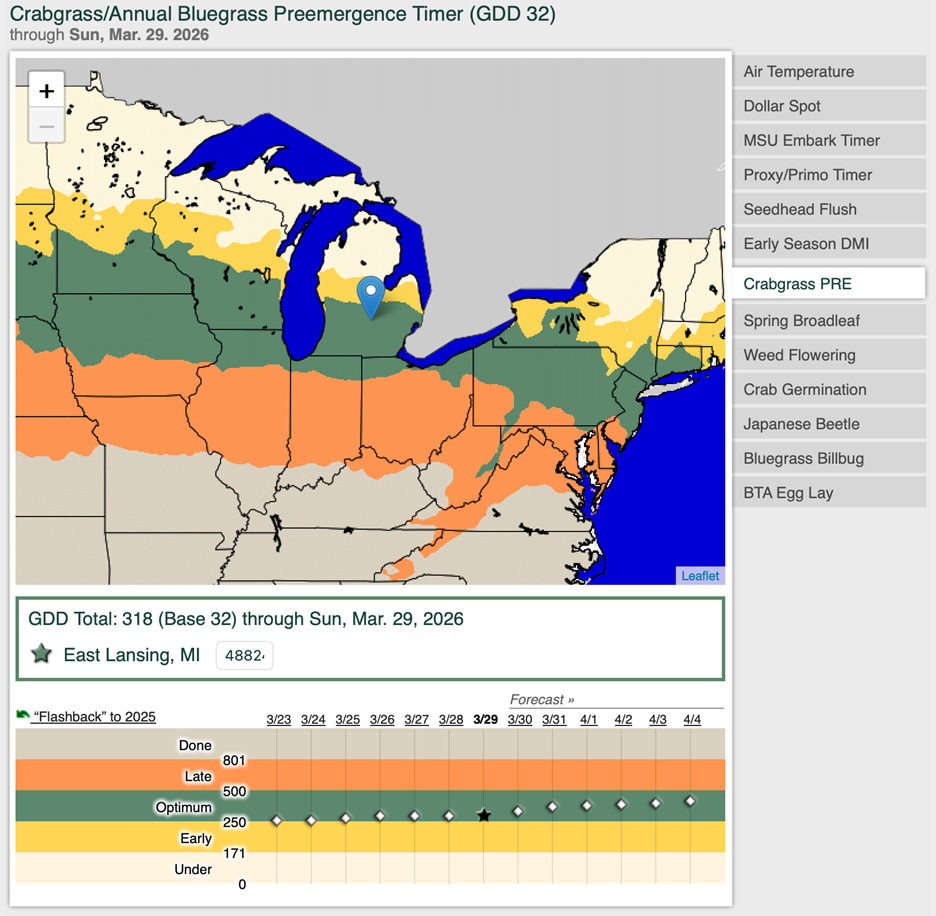 GDDTracker preemergence model for East Lansing, Michigan, through March 29, 2026. Green shading on the map indicates optimum, yellow shading indicates early, and orange indicates late for application timing.
Though March 29, mid-Michigan south to the border of Indiana and Ohio is in the optimum application timing window for crabgrass preemergence applications. Compared to 2025, GDD accumulation in 2026 is almost identical. On March 29, 2025, East Lansing had accumulated 326 GDD base 32; this year we’re at 318 GDD.
Remember, the GDD models are meant to serve as guides, not absolutes. Keep in mind the range of the optimum application window extends from 250-500 GDD. You don’t have to apply the first day the model indicates optimum. We will stay in the optimum application window for at least two weeks, if not longer, depending on daily temperatures moving forward.
In addition to using soil temperatures and GDDTracker, a good environmental indicator for preemergence timing is when forsythia bushes are blooming with their bright yellow flowers. It’s interesting that many years the optimum application timing window determined by growing degree days aligns with forsythia bloom, but so far this year forsythia bloom seems to be lagging, perhaps due to the many recent nights of very cold temperatures in the teens and 20s.
Remember, the practices that encourage a healthy, dense turf stand, such as mowing high, returning clippings and adequate fertilization, are all part of an effective crabgrass prevention strategy.
This work is supported by the Crop Protection and Pest Management Program [grant no 2024-70006-43569] from the USDA National Institute of Food and Agriculture. Any opinions, findings, conclusions, or recommendations expressed in this publication are those of the author(s) and do not necessarily reflect the view of the U.S. Department of Agriculture.