Originally published by the USGA Green Section (Green Section Record, Vol. 64, Issue 21, November 20, 2026).
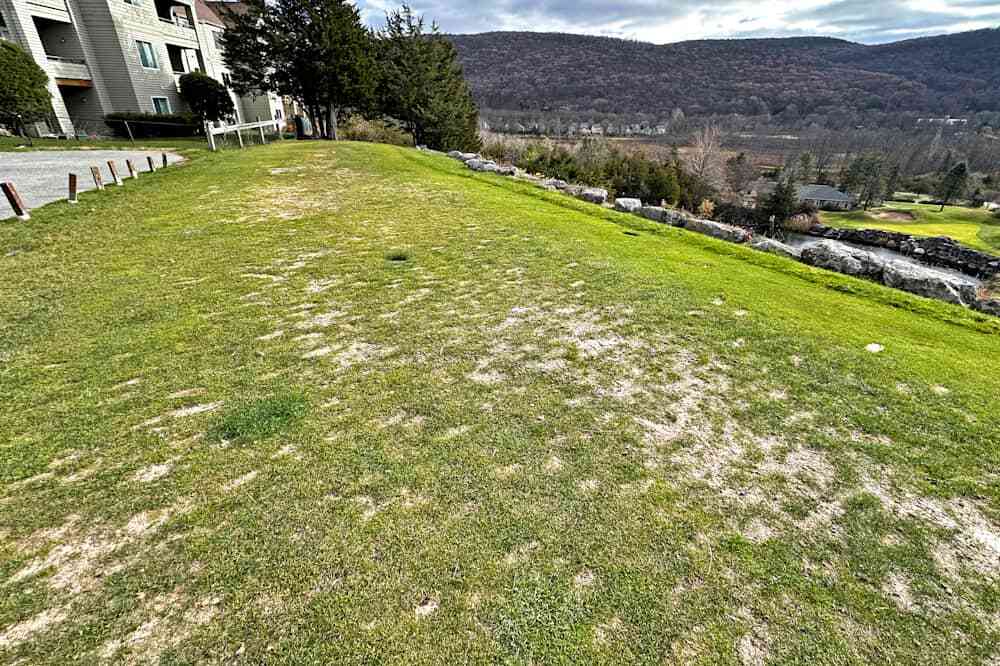
Many golf courses have tees that are not big enough to handle the amount of play we are currently seeing.
By: Brian Gietka, agronomist, East Region
When it comes to tees, most golfers just want a level surface and a good stand of turf to hit from. However, maintaining those traits is easier said than done, and sometimes tees need renovation to keep performing as desired. Many factors influence a tee’s lifespan – a big one is the constant cycle of taking divots and filling them. As divots are made and replaced, or filled with divot mix, the surface often becomes increasingly uneven. Divots tend to be concentrated in the middle of most tees, and as they are filled over the years, tees often develop a crowned shape with a high center and lower edges. The edges are actually at their original elevation, they just haven’t gotten nearly as much divot mix over the years. This crowned shape limits the amount of usable area as golfers struggle to find a level lie, which can lead to uneven wear and poor turf conditions.
Another factor is encroaching vegetation. When trees or shrubs around or beyond a tee cause golfers to favor one side of a teeing ground more than the other, the total usable space is effectively cut in half, which can lead to excessive wear on the part of the tee golfers want to use.
A tee might have been constructed with enough usable area, but when various factors render some parts of the tee surface useless, the ability to move tee markers decreases. With many golf courses hosting historically high numbers of rounds, it becomes a serious problem when tees are worn out and there’s nowhere to set tee markers. Limited space for tee marker rotation, uneven surface conditions, recurring turf loss, and challenges maintaining uniform moisture indicate a need for tee renovations.
In cases of mild crowning, consider aerating the high areas twice with hollow tines, removing the cores, and plate tamping to smooth the surface. This may need to be done more than once to have the desired effect. If the crowning is more severe, there may be no option but to remove the turf and regrade the surface. When there is a combination of factors creating problems or when the original usable space could be restored but would still not provide enough tee surface to accommodate today’s number of rounds, then a tee renovation is likely necessary. This is often the case on par-3 tees that weren’t built for the amount of play they are getting today.
If tee renovations are necessary, make sure to address growing environments, ensure proper alignment, improve drainage, restore a healthy rootzone mix, and choose a grass that gives you the best chance of success. Also, do not skimp on increasing the overall tee size to ensure plenty of usable space for years to come. For assistance evaluating your tees and planning for renovations, reach out to your USGA regional agronomist.
Northeast Region Agronomists:
Darin Bevard, senior director, Championship Agronomy – dbevard@usga.org
Elliott L. Dowling, regional director, East Region – edowling@usga.org
Brian Gietka, agronomist – bgietka@usga.org
Information on the USGA’s Course Consulting Service
Contact the Green Section Staff